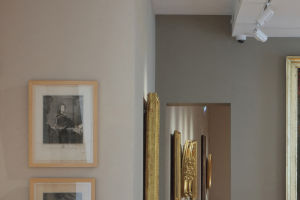
A successful gallery arrangement gives every artwork a clear presence while creating a unified visual experience.
Color, proportion, lighting, and placement determine how individual pieces interact and how visitors experience the room.
Strong abstract paintings can coexist with understated landscapes when the composition is carefully planned and the surrounding space remains uncluttered.
Establish a Focal Point
A bold painting can anchor the room when displayed on a freestanding pedestal or low platform in a central position. Rich combinations of orange, yellow, purple, and blue naturally draw attention and provide a visual starting point for the rest of the collection.
Deep neutral walls can strengthen this effect by creating contrast without competing with the artwork. Smaller pieces positioned around the perimeter should have enough separation to remain distinct, creating a calm transition from the central work to the surrounding displays.
Build Cohesive Wall Arrangements
A horizontal sequence of framed paintings can create rhythm along a lighter wall. Positioning a larger work between smaller pieces establishes hierarchy while maintaining visual balance.
Landscape paintings featuring open water, distant fields, tall grasses, or restrained horizon lines can provide a gentle counterpoint to expressive abstract compositions. The difference in subject matter adds interest without requiring a dramatic change in presentation. Frames with a consistent finish can reinforce the connection between works while allowing their individual styles to remain visible.
Shape the Atmosphere with Lighting
Lighting should reveal the artwork without becoming a distraction. Adjustable track lights and ceiling-mounted spotlights allow illumination to be directed toward individual pieces, helping emphasize color, texture, and surface qualities.
Landscape works can benefit from softer illumination, while a central statement piece may require more focused light. Fixtures should be positioned carefully to limit reflections and glare, particularly on framed artwork with reflective surfaces. A consistent lighting approach also creates a smoother transition as visitors move through the gallery.
Consider Scale and Circulation
Artwork should be arranged in proportion to the available space. A substantial central piece needs sufficient room around it so visitors can approach comfortably and view it from different distances.
Wall displays benefit from clear alignment and measured spacing. Varying artwork sizes can add depth, but the largest piece should have enough surrounding space to retain its visual authority. Walking routes should remain open, allowing visitors to move naturally between displays without interrupting the composition.
The arrangement should also remain convincing from multiple viewpoints. A display that works from the entrance should continue to feel balanced from seating areas and other positions throughout the room.
Protect the Collection
Environmental conditions should be considered when selecting locations for artwork. Prolonged exposure to direct sunlight or intense illumination can contribute to fading, making careful placement and controlled lighting important for long-term presentation.
Hanging hardware should be selected according to each frame's weight, construction, and mounting requirements. Secure installation keeps pieces stable and properly aligned while supporting a polished presentation.
A restrained setting often provides the strongest backdrop. Clean walls, coordinated frames, controlled lighting, and sufficient space allow the artwork to remain the central feature of the room.
An effective gallery display is built on visual relationships rather than isolated placements. A defined focal point, complementary wall groupings, controlled lighting, appropriate scale, and thoughtful circulation can transform a collection into a cohesive presentation. When each element supports the artwork without competing for attention, the gallery feels refined, balanced, and engaging.